At Lincoln Gardens Primary School, we believe that as well as supporting children to be the best they can be academically, it is even more important to support children to be the best they can be both socially and personally.
There is mounting research that suggests that a person’s mental wellness has a significant impact on their ability to learn, enjoy life experiences and form positive relationships. For this reason, Social, Emotional and Mental Health (SEMH) provision is weaved throughout the school curriculum and daily experiences. We are committed to supporting the emotional health and wellbeing of our pupils and staff. We know that everyone experiences life challenges that can make us vulnerable and at times, anyone may need additional emotional support. We take the view that positive mental health is everybody’s business and that we all have a role to play.
At our school we:
- help children to understand their emotions and feelings better.
- help children feel comfortable sharing any concerns or worries.
- help children socially to form and maintain relationships.
- promote self-esteem and ensure children know that they count.
- encourage children to be confident and ‘dare to be different’.
- help children to develop emotional resilience and to manage setbacks.
We follow the Five Ways to Wellbeing to help us on our school journey:
Wellbeing Team

Wellbeing
Miss A Nuttall
Wellbeing
Mr C Jackson
Wellbeing
Mrs A Benson
Wellbeing
Miss L Taylor-Greenwood
Whole School Pupil Ambassador
Max A
Whole School Pupil Ambassador
Grace D
5 Ways to Wellbeing
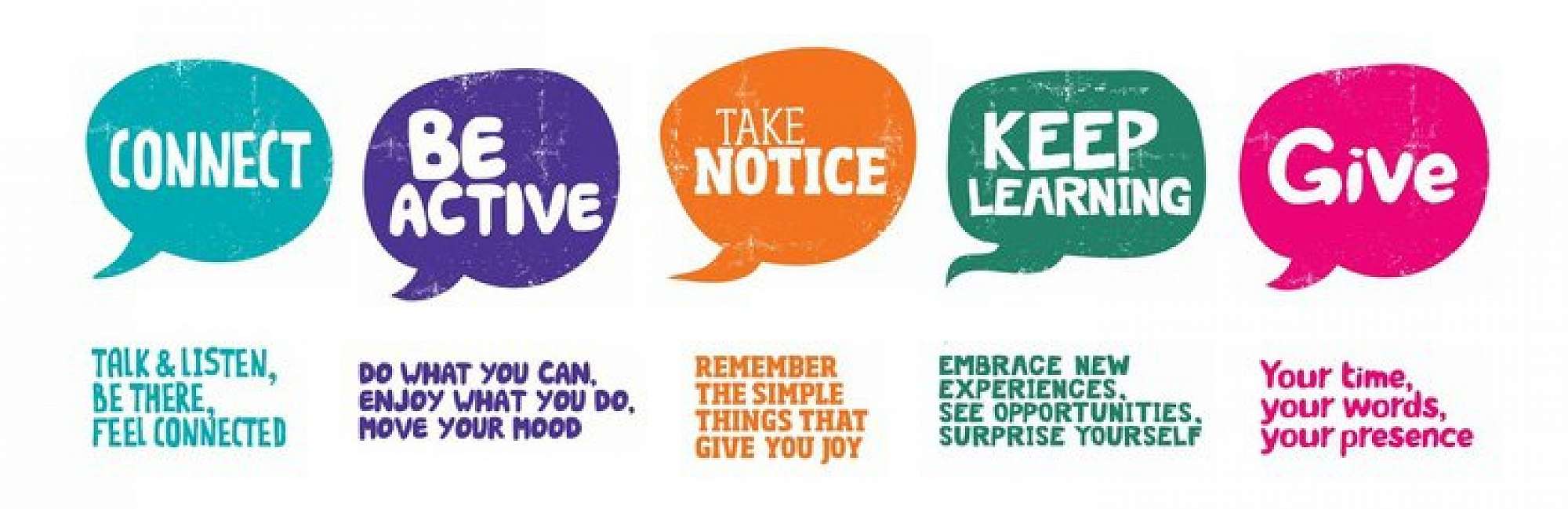
Good relationships are important for your mental wellbeing. They can:
- help you to build a sense of belonging and self-worth
- give you an opportunity to share positive experiences
- provide emotional support and allow you to support others
At LGPS we foster positive relationships with all members of the school community, child to child, child to adult and adult to adult.
- Keeping in touch with others and the wider school community- Ashby Wesley, community groups. Daily meet and greets
- Sharing their positive experiences and successes through our Achievement Tree
- Our various leadership roles in school- Head Boy and Head Girl, sports captains, house captain, student councillors, BV ambassadors and playground buddies
- Being a member of one of our 5 houses- Polar, Jungle, Mountain, Desert or Ocean
- Participating in whole school assemblies
- Working with children in different year groups e.g. reading buddies
- Collaborating with peers during learning activities
- Completing activities off the ‘bucket list’
- Daily engagement with the schools ‘learning behaviours’
- Being provided with an active voice
- Links with the community – local food bank, church and care home
- Openly talking to trusted adults
Being active is not only great for your physical health and fitness. Evidence also shows it can also improve your mental wellbeing by:
- raising your self-esteem (see more: NHS raising your self-esteem)
- helping you to set goals or challenges and achieve them
- causing chemical changes in your brain which can help to positively change your mood
- Morning Move Its, PE sessions, Brain Break activities, active lessons, play, weekly mile. Participating in daily ‘Morning Move-it’
- PE lessons
- Swimming lessons
- Extra-curricular clubs
- Representing the school at sports events
- Sports day
- Inter-house competitions
- Completing the daily walk to school tracker
- Participating in various initiatives e.g. Skip for Life
Research shows that learning new skills can also improve your mental wellbeing by:
- boosting self-confidence and raising self-esteem
- helping you to build a sense of purpose
- helping you to connect with others
- Even if you feel like you do not have enough time, or you may not need to learn new things, there are lots of different ways to bring learning into your life.
- Following a broad and balanced curriculum, opportunities to try new activities in the year group bucket lists, visitors and visits to inspire us
- being exposed to an ambitious, broad and balanced curriculum whereby new skills are introduced in each year group
- enrichment opportunities from visitors coming into school or by going on school trips
Research suggests that acts of giving and kindness can help improve your mental wellbeing by:
- creating positive feelings and a sense of reward
- giving you a feeling of purpose and self-worth
- helping you connect with other people
It could be small acts of kindness towards other people, or larger ones like volunteering in your local community.
- supporting a variety of charities with huge success, such as Jeans for Genes day, MacMillan Coffee evenings, CIN and Red Nose day etc.
- Nominating daily behaviour for learning pupil
- Kindness Cup in Out of this World Assembly
Giving our time to others, Jigsaw and PHSCE activities, involvement in charities and awareness days such as “Children in Need”, “Red nose Day”, “Operation Christmas Child” Macmillan Coffee Morning and many others.
Paying more attention to the present moment can improve your mental wellbeing. This includes your thoughts and feelings, your body and the world around you.
Some people call this awareness “mindfulness”. Mindfulness can help you enjoy life more and understand yourself better. It can positively change the way you feel about life and how you approach challenges.
Paying more attention to the present moment can improve your mental wellbeing. This includes your thoughts and feelings, your body and the world around you.
Some people call this awareness “mindfulness”. Mindfulness can help you enjoy life more and understand yourself better. It can positively change the way you feel about life and how you approach challenges.
Paying more attention to the things around us can make us feel calm and peaceful. At LGPS we use Mindfulness activities such as breathing techniques and yoga to achieve this.
SEND
Downloads & Links
Information
Special Educational Needs and Disability Coordinator (SENDCo): Mrs C Bradley
SEND and Inclusion Governor: Charlie Lowe
We aim to meet the needs of all individuals within our school. Occasionally some children experience greater difficulties in aspects of their learning than others. They may be identified as having Special Educational Needs and Disabilities. In line with the new Special Educational Needs and Disability (SEND) Code of Practice, (September 2014) these children are offered additional support in a range of different ways targeted to meet their individual needs.
The progress of these children is closely monitored and reviewed at regular intervals by teachers and with children and parents. If required, the school is able to access many support agencies provided by the Local Authority and Health Authority in order to help meet their needs.
Involvement of children and families are at the heart of the SEND reforms, at Lincoln Gardens Primary School we provide a person centred approach to identify, assess and improve outcomes for children and young people with Special Educational Needs and Disabilities.
In order to keep families at Lincoln Gardens Primary School fully informed of what we offer for their children with SEND, we have produced a series of questions and answers which gives information on how all children are included and supported in their development through their time at our school. Please see SEND Information tab.
The North Lincolnshire Local Offer gives information of what support and services are available from the Local Authority for children and young people with SEND and their families. Follow the link below to the North Lincolnshire Council website for more information.
Online Safety
Downloads & Links
Information
The online world is rapidly developing and many of our children now have access to devices which enable them to connect to the internet, take images or video and communicate with others. While it is important not to obstruct them from developing skills from using these devices, it is essential that parents support their children in navigating the online world.
Some of the issues related to children using the internet are:
- Accessing inappropriate content on the internet
- Using ‘mature’ social networking sites, such as Facebook, and connecting with individuals they don’t know
- Being cyber bullied by others on the internet
- Using technology appropriately, e.g. webcams and cameras on mobile devices
- Sharing personal information with others they don’t know on the internet
- Playing video games with adult rating, e.g. Call of Duty.
If you feel that your child is being groomed or abused online, then use the Child Exploitation Online Protection (CEOP) Centre’s reporting form:
Smartie The Penguin (online story)
https://www.childnet.com/resources/smartie-the-penguin/
Digiduck’s Big Decision (online story)
https://www.childnet.com/resources/digiduck-stories/
Hectors World (cartoons)
https://www.thinkuknow.co.uk/5_7/hectorsworld/
Lee & Kim (cartoon and resources)
The Smart Crew (cartoons and resources)
https://www.childnet.com/resources/the-adventures-of-kara-winston-and-the-smart-crew
CEOP Think U Know 8-10 year olds (games and resources)
https://www.thinkuknow.co.uk/8_10
CEOP ‘Jigsaw’ (video)
https://www.youtube.com/watch?v=_o8auwnJtqE
YHGfL ‘Daydreaming’ (cyberbullying video)
https://www.yhgfl.net/content/download/3316/21955/file/Daydreaming.avi
News and Information for Parents
http://www.theparentzone.co.uk/parent
CEOP Parent’s guide to the internet (video)
https://www.thinkuknow.co.uk/parents/parentsguide
CEOP Primary parent’s site (advice)
https://www.thinkuknow.co.uk/parents/Primary
ParentPort (advice)
https://www.parentport.org.uk/top-tips-for-parents
UK SIC Guide to technology (advice)
https://www.saferinternet.org.uk/advice-and-resources/parents-and-carers/parents-guide-to-technology
Pan European Game Information (advice)
Wellbeing Resources
Downloads
Information
These links provide useful resources related to wellbeing.


